Ask people what they remember about arriving at a home and they rarely mention the wallpaper. They remember the front gate that stuck, the dark path they had to feel their way along, the hedge that had grown into the doorway, or the pleasing sense that everything had been looked after before they arrived. Curb appeal is not a surface treatment applied at the end of a project. It is the combined effect of a handful of decisions about approach, surface, structure and planting, and it either works as a whole or keeps annoying you in small ways.
This guide walks through the order in which we usually tackle exterior and garden work, because the sequence matters. Deciding on planting before fixing the path, or choosing a colour before repairing the render, almost always ends up costing more than doing it the other way round.
Begin with the approach, not the borders
The approach to a home is the part that answers a simple question: where am I supposed to go? A clear route from gate to door, wide enough for two people to walk side by side and lit well enough to be safe after dark, does more for first impressions than any planting scheme. If your visitors regularly step onto the flower bed to avoid the edge of a path, that path is too narrow — no amount of good landscaping will fix a route that is the wrong size.
When we survey an approach, we look for awkward transitions: a step of an inconsistent height, a slippery patch where paving holds water, a gate that drags across the ground, or a direction change with no visual cue. These are the details people notice without being able to explain why. Fixing them is usually inexpensive and immediately noticeable.
Repair surfaces before decorating anything
Exterior work begins with the structure of the house itself: cracked render, blown paint, failed sealant, blocked gutters, loose coping or a fence that has started to lean. It is tempting to skip past this and go straight to the part that changes how things look, but paint applied over damp render will simply fail again, and a new colour on a wall with a water problem is money spent twice.
Once surfaces are sound and dry, the decorating decisions become straightforward, and everything you add on top of them lasts longer. This is also the moment to check drainage, because water that collects against a wall is the root cause of a surprising number of exterior problems, from staining to damp appearing inside a room.
Choose an exterior palette that suits the building
Exterior colour has to live with fixed materials you cannot easily change: brick, stone, roof tile, window frames, driveway paving. Instead of picking a colour you like in isolation, look at the permanent surfaces on an overcast day, when their true tone is easiest to read, and choose a palette that either harmonizes with them or deliberately contrasts in a considered way. Deep browns, greens and greys tend to sit comfortably beside natural stone and brick, while a crisp light neutral on trim gives the whole elevation a sharper edge.
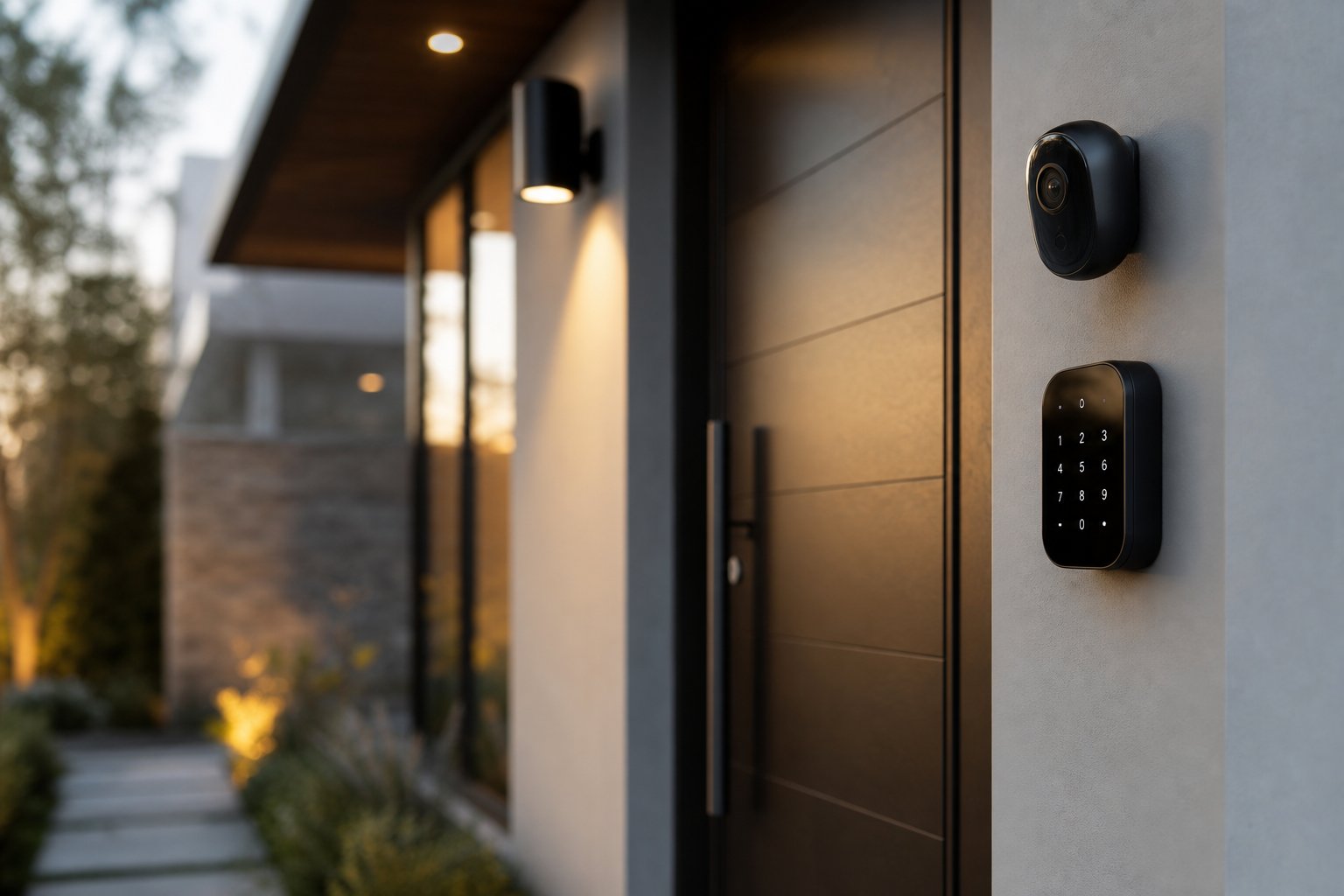
Remember that the front door is the focal point of the approach. One confident colour on the door, repeated on nothing else except perhaps a house number plaque or a pot, creates a welcome that is visible from the street without looking scattered.
A garden does not have to be elaborate to look intentional. A clear route, one clipped structure and one confident colour will do more than a crowded border of unrelated plants.
Use planting in layers rather than rows
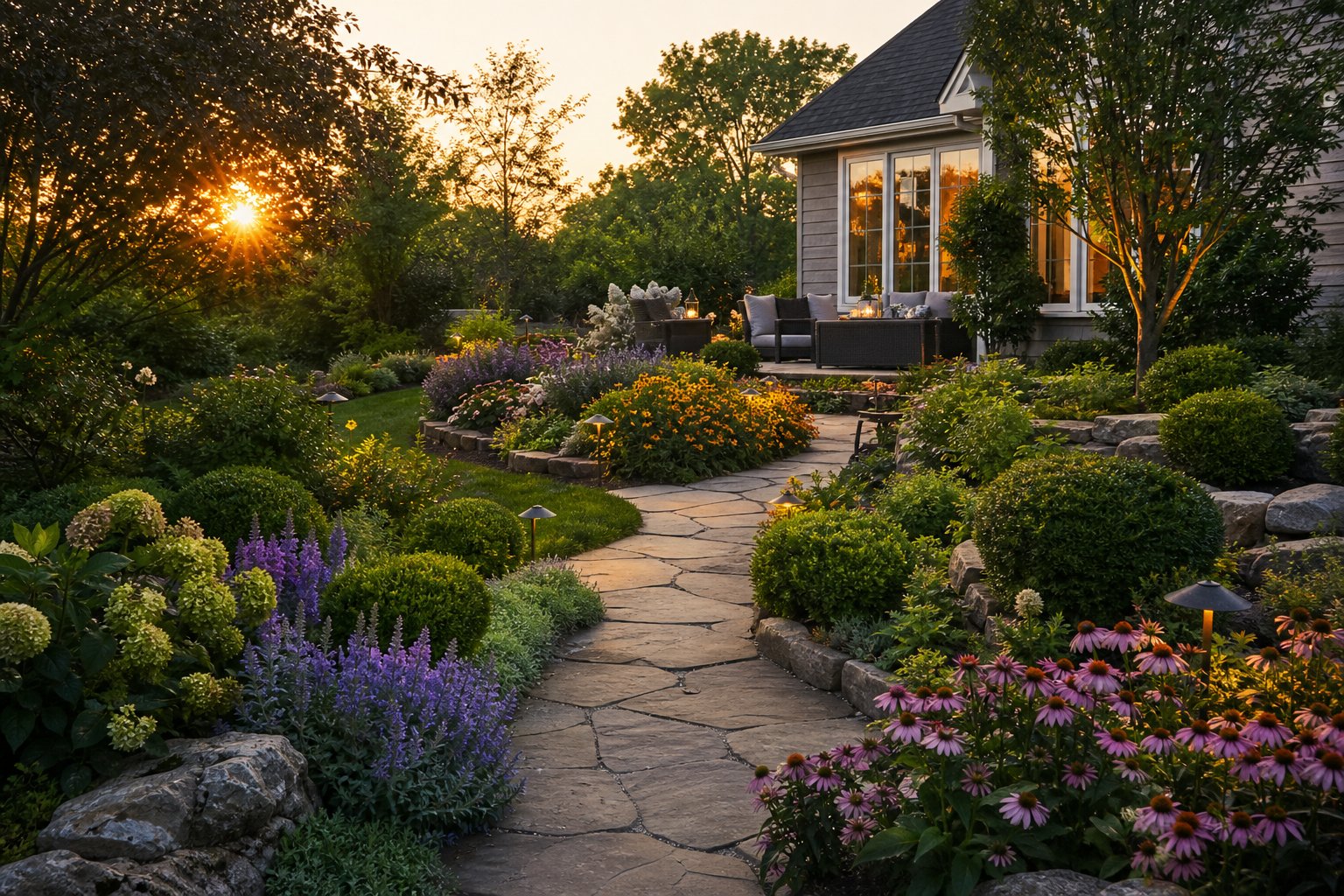
Planting looks mature and generous when it is arranged in layers: ground cover to soften hard edges, mid-height shrubs for mass and scent, taller structural plants for shape, and something seasonal that earns its place for a few weeks and then fades politely into the background. The key is that each layer does a job, and the front-most plants are low enough that they do not obscure the path or the door.
Choose species that suit the conditions you actually have, not the conditions you would like. A sun-loving flowering shrub placed in shade will sulk for years, while a plant matched to your soil, light and rainfall will establish quickly and need far less attention. Ask about mature size at the nursery — the label's small figure is often what it looks like in its first season, not in five years' time.
Make hard landscaping earn its place
Paths, steps, patios and driveways carry the heaviest traffic and are worth building well. Slightly wider steps with a consistent rise, paving that falls gently away from the house, edging that holds the gravel in place, and a material that stays tolerable underfoot in wet weather will all outlast fashion. In small gardens, a single material used consistently at the front usually reads better than a mixture of three.
We also recommend thinking about where the garden will be used, not just how it will be seen. A paved area that catches the last of the daylight, positioned near the kitchen door, will be used constantly. The same paving in a shady corner will be admired and then ignored. Outdoor sockets and a tap positioned sensibly at the planning stage are far cheaper than retrofitting them later.
Light it properly and keep it subtle
Garden lighting should help you move around and reveal the structure of the space, not flood it. Uplighting a single tree or wall, or placing a few small warm fixtures along the path at intervals, is usually enough. Fittings that glare directly into the eye make the dark parts of the garden feel darker, which defeats the purpose.
Practical lighting matters just as much: a warm light beside the front door so guests can see the bell, a fixture near the step that always feels uncertain in the dark, and a security light that can be switched independently of the decorative scheme. Set it all on a timer or sensor and the difference in how the property feels at night is immediate.
Maintain what you build, and it will keep looking new
The final layer is maintenance, and it is the one most often overlooked. A small routine — clearing leaves from drains before the wet season, cutting back the plants that crowd the path, refreshing gravel, checking sealant around windows and doorways, and touching in any paint that has chipped — protects everything you have invested in and takes far less effort than a rescue job later.
Where the front age is concerned, the most useful habit is to walk to the end of your path and turn around as though you were seeing the house for the first time. That view tells you what visitors see: the route, the door, the light, the planting, and whatever has quietly fallen into disrepair. Deal with the first thing your eye lands on, then repeat. It is a simple method, and it keeps a home's welcome in good order for years rather than weeks.
If you would rather hand the whole job over, that is exactly the kind of project we plan from the survey inwards — exterior repairs, hard landscaping, planting and lighting, sequenced so that each stage supports the next.